
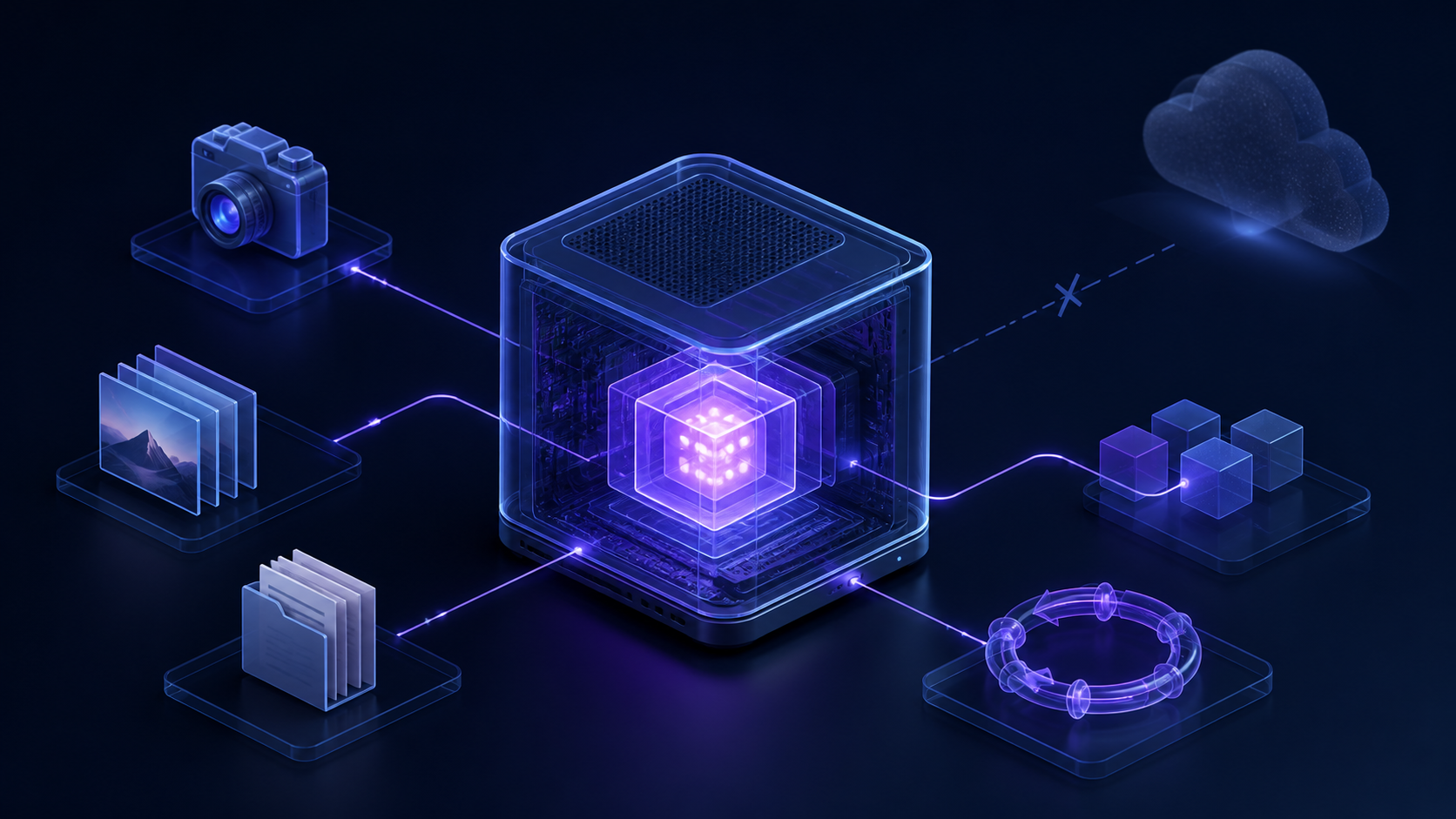
Meta’s Muse Glimmer is designed to put a capable AI agent on a personal computer rather than behind a cloud API. That changes more than latency and cost. When the model, memory and tools can all operate locally, the device itself becomes the control plane.
Released on 10 August 2026, Muse Glimmer is a 30-billion-parameter multimodal model from Meta Superintelligence Labs. Meta has published its weights under the permissive Apache 2.0 licence and optimised a quantised version to fit inside a 24GB or 32GB memory envelope. The company says it can plan, use tools, recover from failed calls, interpret text and images, and work across more than 100 languages.
The headline is not that a small model has matched every frontier system. Meta’s own comparisons show a mixed field in which Glimmer performs strongly for its size on some agentic, coding and multimodal tests. The more consequential development is architectural: useful agent capability is moving onto hardware that an individual or organisation can physically control.
That creates an alternative to sending every document, screenshot, instruction and intermediate result to a remote provider. It also transfers responsibility. A local model can reduce one set of dependencies while placing security, updating, logging and permission design closer to the user.
Why fitting on one device matters
At full precision, Meta says a 30-billion-parameter model would require more than 55GB of memory. Muse Glimmer’s roughly four-bit quantisation reduces the language model to under 20GB, leaving space for working memory, its image-perception encoder and a speculative-decoding component. Meta reports testing the resulting configuration on 24GB and 32GB systems, including Apple silicon and an RTX 5090.
That memory target matters because it moves agent deployment out of the data centre. A workstation, high-end laptop or compact local server can potentially run the model without a permanent network connection. For some workflows, the benefit is privacy: raw material can remain within a controlled environment. For others, it is resilience, predictable cost or the ability to operate where cloud access is unavailable or prohibited.
Local execution can also make repeated agent loops economically practical. An agent may call a model many times while planning, checking a result, recovering from failure or interpreting a changing interface. When every step is a metered cloud request, long-running tasks accumulate variable cost. Local inference converts more of that cost into hardware and power already under the operator’s control.
None of this means local is automatically cheaper or greener. Hardware still has to be bought, secured, powered and replaced. Performance depends on the quantisation, context length, workload and software stack. Meta’s results are vendor-reported, and independent users are only beginning to test the release. But Glimmer’s form factor makes local agents a realistic design option rather than a specialist experiment.
An agent is more than the model
Meta presents Glimmer as an agentic model rather than a chat model. It has been trained for end-to-end task completion, precise function calling, extended reasoning, failure recovery and compatibility with agent scaffolds. Those capabilities are useful, but they should not be confused with operational authority.
A model can propose a file change, issue a tool call or decide to retry. The surrounding system decides whether that request is allowed. It holds the credentials, defines the available tools, constrains file and network access, records actions and asks for approval. If a locally running agent can reach an email account, shell, home-automation system and personal documents, “it runs on my device” is not a security control. It is a description of where the risk is concentrated.
OWASP’s current agent-security guidance recommends least-privilege tool access, explicit approval for high-impact actions, isolation of memory and context, structured logging and limits on retries and tool chains. NIST’s agent-standards work similarly focuses on identity, authorisation, auditing and the binding of an agent’s authority to a person.
These principles apply whether the model is proprietary or open, remote or local. Our earlier article AI Agents Need Identity and Authority, Not Just Better Prompts makes the operating-model point directly: intelligence does not grant permission. The agent should receive a task-bound identity and only the authority required for that task.
Local can improve privacy without guaranteeing it
A local model can keep sensitive inputs off a third-party inference service. That is meaningful for confidential research, regulated data, source code and personal records. It can also make data residency easier to explain: the model executes within an environment the organisation controls.
But the complete workflow may still communicate externally. Tools can call APIs, retrieve web pages, synchronise files, send telemetry or install packages. An agent may copy sensitive context into a search query or transmit it through a connected service. Logs and cached embeddings may remain on disk long after a task ends. A compromised plugin or model-serving package can turn a privacy-preserving design into a supply-chain problem.
Privacy therefore has to be verified at the system boundary, not inferred from the model location. Teams should document which components can access the network, where prompts and tool results are stored, how credentials are isolated, what telemetry is enabled and how temporary artefacts are removed. A useful test is simple: can the operator show, rather than merely assert, that the sensitive data stayed local?
Open weights are valuable, but the terminology matters
Meta describes the release as open-sourcing the model weights under Apache 2.0. That licence gives developers unusually broad freedom to download, run, modify and redistribute the released artefact. The practical benefits are substantial: independent deployment, community optimisation, fine-tuning and inspection that a closed API cannot offer.
However, open weights are not necessarily the same as a fully open-source AI system. The Open Source Initiative’s definition also considers the training and data-processing code, model architecture and sufficient information about the data used to derive the parameters. Publishing the final weights provides the result of training, not a complete recipe for reproducing the system.
This is not a criticism of the release’s usefulness. It is a request for precision. “Open weights” tells buyers and developers exactly what important freedom they have. “Open source” can imply a wider level of reproducibility and transparency than a weights release alone provides. Governance improves when these distinctions are recorded rather than blurred by marketing language.
Updates become the operator’s problem
Cloud models hide much of their maintenance. The provider patches infrastructure, deploys new versions and absorbs operational incidents, although customers may then face behaviour changes they did not control. Local deployment reverses the trade-off. Operators can pin a version and test changes on their own timetable, but they also have to notice vulnerabilities, validate new weights and maintain the serving stack.
For an agent, the deployed version is only one part of the configuration. Tools, system prompts, memory, retrieval sources, permissions and orchestration software can all change behaviour. A useful release process should record the hash of the model artefact, quantisation, runtime, tool policy and evaluation suite. Material changes should trigger regression and abuse-case testing before the agent returns to production.
That evidence becomes especially important when local models are downloaded informally across a business. A team may believe it has avoided supplier risk while introducing an untracked model, an unreviewed quantisation or a community package with broad device access. Local autonomy without asset management can become local opacity.
The review model described in AI-Assisted Coding Needs a Spectrum of Human Review applies here too: human involvement should increase with consequence and irreversibility. A local agent summarising private notes does not need the same controls as one that can modify production code, send external messages or operate physical devices.
The strategic value is optionality
Muse Glimmer does not eliminate the cloud. Larger hosted systems will remain preferable when maximum capability, central management or elastic scale matters most. Local models will be attractive where confidentiality, offline operation, predictable cost or control over versions outweighs the performance gap.
The more interesting future is likely hybrid. A local agent can handle sensitive context, routine classification and low-risk actions, escalating selected problems to a stronger remote model under explicit rules. That design can minimise data exposure and cloud cost while preserving access to frontier capability when it is genuinely needed.
To make that credible, organisations need to decide what may leave the device, what evidence supports escalation, which model receives the task and who owns the resulting decision. Otherwise “hybrid” becomes an invisible routing layer that nobody can audit.
Muse Glimmer’s real contribution is not a claim that a 30-billion-parameter model has replaced the frontier. It is proof that the deployment boundary is moving. When an agent can live on the device, model access becomes more distributed and provider dependence can fall. The quality of governance must move with it.
Sources
- Meta AI Research: Introducing Muse Glimmer
- Meta’s Muse Glimmer model release on Hugging Face
- Open Source Initiative: Open Source AI Definition 1.0
- OWASP: AI Agent Security Cheat Sheet
- NIST: AI Agent Standards Initiative
How we work: Artificially Confident articles are source-led, AI-assisted and editorially reviewed.