
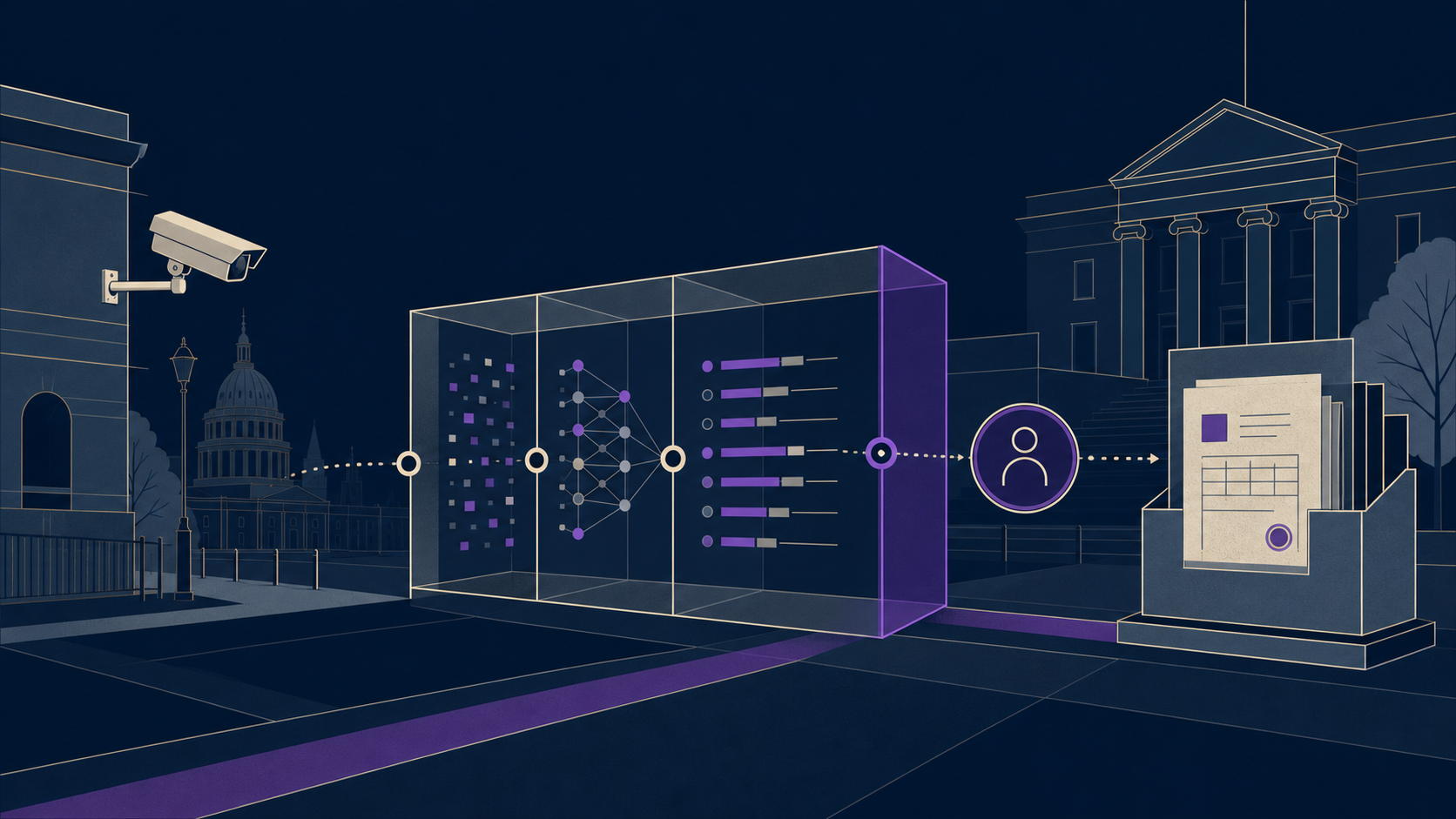
Britain is about to put more AI into policing. The government has announced PoliceAI, a national centre intended to speed up adoption, with pilots for triaging and summarising digital evidence, more live facial-recognition capacity and a planned public register of tools in use. The case for some of this is straightforward: investigations now generate vast quantities of digital material, and officers should not have to spend their working lives manually redacting video or searching duplicated files.
But the most revealing recent UK police AI story is not a successful pilot. It is the parliamentary inquiry into the decision to exclude Maccabi Tel Aviv supporters from an Aston Villa fixture last year. The Home Affairs Committee found that West Midlands Police had relied on inaccurate and unverified information, including material generated through Microsoft Copilot, when building part of its intelligence picture. That information was used in a decision with real consequences for people, public trust and community relations.
This should not be turned into the lazy conclusion that every police officer is incapable of using AI, or that every AI-assisted task is inherently unsafe. It is more serious than that. It shows what happens when an organisation introduces a persuasive new tool without an equally clear operating model for checking, escalating, recording and owning its use.
The problem is not simply accuracy
Generative AI gets things wrong. That is not news. It can produce a confident summary that contains invented detail, merge unrelated events or repeat a weak source in fluent language. In a low-stakes setting, the answer may be an embarrassing error. In policing, it can alter how risk is framed, who is treated as a threat and whether a decision survives scrutiny.
The Committee’s report is striking because it describes more than a bad output. It describes a broken decision route. Material that supported a pre-existing narrative was accepted; contradictory evidence from authoritative sources was not given enough weight. A fictitious fixture and other claims entered the account. The use of AI was itself not properly surfaced or understood at senior level in time for accurate evidence to Parliament. That is not a prompt-writing failure. It is a governance failure.
Every public authority already knows, in principle, that intelligence should be assessed, sourced and challenged. AI does not remove those obligations. It increases the need to apply them, because it makes it cheap to generate a lot of plausible-looking material very quickly. The danger is not that a model replaces professional judgement overnight. The danger is that uncertain material quietly acquires the status of professional judgement as it moves through a briefing, a meeting and a decision.
The national response acknowledges the gap
There is a tension at the centre of the current policy moment. Ministers are rightly focused on the operational upside: faster handling of digital evidence, less repetitive work and more capacity for officers to investigate. At the same time, the new programme promises a public registry, independent testing for accuracy and bias, and governance support. Those are welcome commitments. They also reveal that the common baseline has not yet been fully built.
That matters because police forces do not deploy AI into a neutral environment. They use it alongside existing powers, intelligence processes, data-protection duties and decisions that can affect liberty, safety and community confidence. The higher the consequence, the less adequate it is to say that a human remains in the loop. The real question is what that human is expected to do, what evidence they can see, and whether they have enough time and authority to challenge the output.
Recent research from Northumbria University makes a similar point. Its mapping of probabilistic AI across the criminal justice system found adoption moving faster than the safeguards intended to govern it. The useful takeaway is not a call to freeze every experiment. It is that scale without an operating discipline creates a patchwork: one team may have robust checking and records, while another treats an AI-generated answer as a useful shortcut and moves on.
What “knowing how to use it” actually means
Knowing how to use AI in policing is not just knowing where the button is. It means being able to answer a small set of practical questions before an output influences a real decision.
- What is the tool doing? Is it retrieving material, summarising it, ranking risk, generating prose or identifying a person? These are not interchangeable activities and should not have the same controls.
- What is the source? Can an officer or decision-maker trace an assertion back to the original intelligence, record or evidence? A fluent answer without provenance is not a reliable briefing.
- What must be checked? A policy needs to make clear which claims need independent verification, who performs it and when that check is recorded.
- Who owns the decision? “Human in the loop” is too vague. Someone needs named responsibility for accepting, rejecting or escalating a material output.
- What happens when the tool is wrong? There should be a route to correct the record, notify people affected where appropriate, learn from the failure and stop repeated use of a faulty pattern.
None of this is exotic. It is the discipline public institutions already use for other kinds of evidence and operational decision-making. The difference is that AI can make it easier to skip the visible parts of that discipline. A system that gives an answer in seconds can make the underlying uncertainty feel smaller than it is.
Transparency is part of operational quality
The promised police AI register is therefore more than a communications exercise. A clear public account of which tools are used, for what purpose, with what data and under what assurance helps create the pressure for better internal practice. It gives communities, oversight bodies and frontline staff something concrete to examine. It also forces a basic distinction that is too often blurred: a tool that organises case files is not the same as a tool that influences a stop, a watchlist, an investigation or a public-order decision.
Transparency alone is not enough. A register can become a list of product names without answering whether a particular force has trained people, completed an impact assessment, tested for error and bias, or established a meaningful challenge process. But secrecy is worse. If a public body cannot explain the role an AI system played after the fact, it has probably not created a sufficiently accountable route for using it beforehand.
The lesson from West Midlands is not to stop innovating
There will be a temptation to treat the Maccabi case as an awkward exception: an individual mistake, a moment of poor judgement, then move on. That would miss the value of the warning. High-consequence use exposes weaknesses that can sit unnoticed in lower-stakes workflows. If a force cannot show how AI-generated material was checked before it affected a sensitive public decision, then the organisation does not yet have the controls required to scale that use safely.
Conversely, a better operating model would not make police work slower or more bureaucratic for the sake of it. It would separate routine assistance from consequential advice. It would make verified sources easy to access, mark AI-derived material clearly, require confirmation at defined points, and preserve a record of the judgement made. Good controls reduce the time wasted later on correction, inquiry and loss of confidence.
That is the real PolicyOps question in public services: not whether an organisation has a policy saying “use AI responsibly,” but whether that policy changes what people do on a busy day. Can an officer see the boundary? Can a supervisor challenge the output? Can an affected community understand what happened? Can an inspector reconstruct the route from input to decision?
Where CopPlan fits
This is exactly the terrain that CopPlan is designed for: helping investigative policing turn work from disparate operational systems, case files, statements, body-worn video and guidance into a clearer supervised workflow. That is a more useful ambition than an AI tool that simply produces an answer. In a policing context, the value is in helping officers and supervisors see the case, the next action and the supporting material without making the system the decision-maker.
The distinction matters. Responsible AI for investigations should reduce administrative drag and improve visibility, while leaving authority with accountable people. It should help users locate the source, identify gaps, prioritise the work and understand why a recommendation appears. It should not turn a probabilistic output into unexamined intelligence. Building those constraints into the workflow is how a platform earns trust in a setting where errors can affect real people.
Move quickly, but make the route visible
UK policing should use technology that genuinely helps it investigate fairly and effectively. The case for better tools to handle digital evidence is strong. But faster adoption cannot be the only measure of success. The standard has to be whether an AI-assisted decision is more accurate, more accountable and easier to explain than the process it replaces.
PoliceAI could be an opportunity to establish that standard nationally rather than leaving each force to invent it under pressure. The early commitments on independent testing, transparency and governance point in the right direction. Now they need to become routine practice, not future aspirations. In a public institution with coercive powers, the answer is never simply “the computer suggested it.”
Sources: House of Commons Home Affairs Committee on the Maccabi Tel Aviv fan-ban inquiry; GOV.UK: PoliceAI announcement; Northumbria University research on safeguards and probabilistic AI.